
From riverside apartments and Victorian terraces to modern business parks, Bedford’s mix of properties demands an experienced and reliable electrical partner. Whether it’s bringing an older installation up to current standards, optimising energy use in a warehouse, or preparing a home for electric vehicle charging, choosing a skilled local professional protects people, property, and productivity. When you need a trusted Electrician in Bedford, it pays to look for proven workmanship, up-to-date knowledge of the latest regulations, and a track record across domestic, commercial, and industrial environments.
Electrical work is not just about “lights and sockets.” It spans design, installation, testing, maintenance, and increasingly, renewable integration. The right team will deliver safe systems that meet BS 7671 (18th Edition) standards, reduce energy waste, and provide clear documentation from start to finish—so landlords, facilities managers, and homeowners can make confident, compliant decisions.
Safety, Compliance, and Testing: The Foundation of Every Bedford Project
Electrical safety begins with robust protection and verified compliance. In many Bedford homes—especially older properties in areas like Castle Quarter or Kempston—upgrading the consumer unit can be the single most important improvement. Modern units combine RCD protection, MCBs, and often AFDDs, helping to prevent electric shock and reduce the risk of fire. A professional inspection evaluates earthing and bonding, cable integrity, and fault protection, and identifies whether a consumer unit upgrade is required for the way you live and work today.
For landlords and business owners, routine inspection is non-negotiable. An EICR (Electrical Installation Condition Report) assesses the condition of fixed wiring, flagging any C1/C2 observations that demand immediate or urgent attention. Bedford’s active rental market—including HMOs and student lets—benefits from clear EICR reporting, ensuring properties meet legal obligations and remain safe for tenants. Complementary to this, PAT testing checks portable appliances for faults, while RCD testing confirms that life-saving devices trip within the required times.
Faults rarely announce themselves; they show up as nuisance tripping, overheating accessories, flickering lighting, or unexplained energy spikes. Skilled fault finding is a blend of experience and instrumentation—using insulation resistance tests, continuity checks, and thermal insights to pinpoint root causes. Whether it’s a damaged cable run in a refurbished office or a deteriorated junction in a loft, rectifying the fault at source prevents repeat issues and protects the rest of the installation.
Commercial and industrial sites across Bedford—offices in the town centre, retail units, schools, factories, and warehouses—also rely on compliant emergency systems. Emergency lighting must be designed, installed, and occasionally upgraded to current guidance. Regular function tests and annual duration tests verify safe evacuation routes. Clear certification, asset registers, and accessible maintenance logs provide transparency for audits and insurance requirements, reducing risk while maintaining operational continuity.
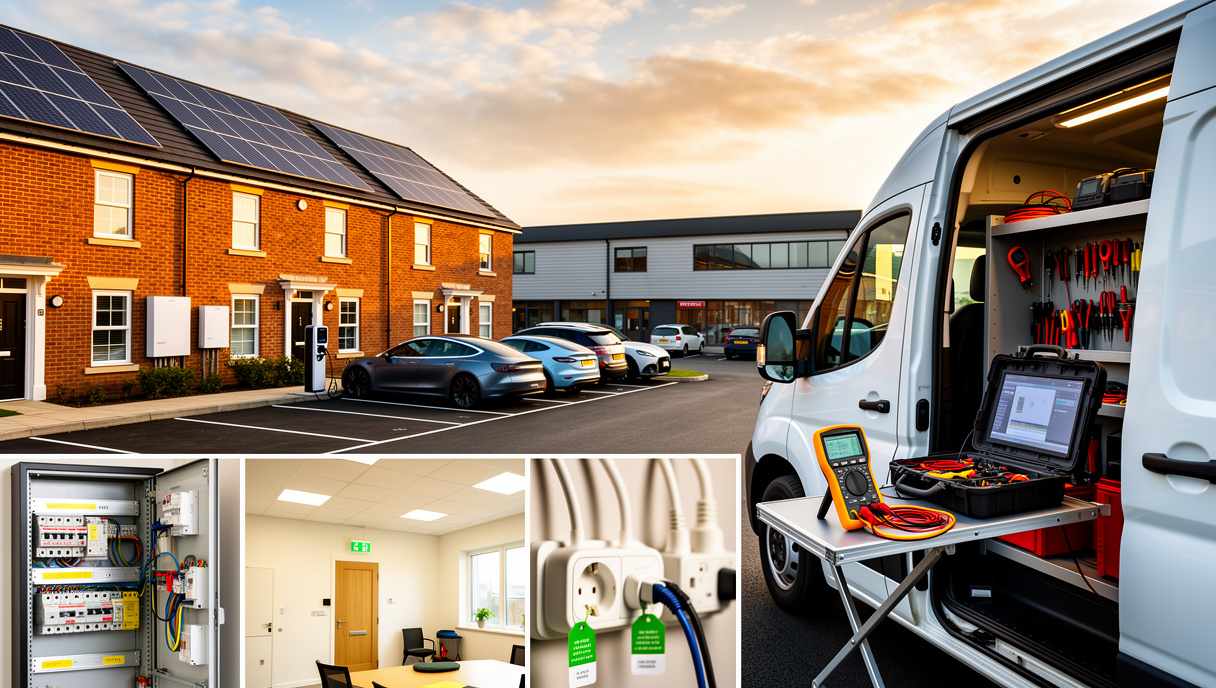
Energy Efficiency and Smart Upgrades: From LED Retrofits to EV, Solar, and Storage
Rising energy costs and carbon targets make efficiency more than a buzzword—it’s a strategic advantage. In Bedford’s homes and businesses, LED lighting retrofits remain a standout upgrade. Beyond the obvious savings, LED systems improve light quality and uniformity, often with a tailored colour temperature for tasks or ambiance. In offices, pairing LEDs with occupancy and daylight sensors can cut lighting energy by 40–60%, extending lamp life and reducing maintenance overheads. For warehouses and industrial floors, high-bay LEDs with smart controls offer precision illumination that supports safety and productivity.
Transport is electrifying fast. Installing a domestic or workplace EV charger requires more than just fitting a unit on a wall; it starts with a load assessment and, where necessary, service upgrades and protective devices. Bedford commuters benefit from overnight charging at home, while businesses can provide staff and fleet facilities with smart load-balancing to prevent demand peaks. Thoughtful placement, cable management, signage, and commissioning all contribute to a dependable charging experience.
Renewable integration is equally transformative. Grid-tied solar panels reduce daytime demand, while battery storage captures surplus energy for evening use, peak-shaving, or backup. For Bedford properties with suitable roof orientation and structure, solar-plus-storage can significantly lower bills and increase energy independence. The design phase should assess inverter capacity, string configuration, shading analysis, and export limitations, with monitoring that provides real-time visibility of generation and consumption. Adding smart immersion controllers, time-of-use tariffs, and, where applicable, EV charging schedules creates a coordinated, efficient ecosystem.
Consider a few local scenarios. A riverside apartment block upgrades corridor and car park lighting to LED with microwave sensors, slashing kWh consumption and improving safety after dusk. A family home in Biddenham installs solar PV with a compact battery, using stored energy to cook dinner and charge an EV at off-peak times. A logistics unit near Wixams retrofits to daylight-harvesting high-bays and optimised task lighting, enhancing visibility while reducing maintenance visits. In each case, success hinges on accurate load calculations, appropriate protection, neat installation, and thorough handover—complete with user guidance and certification.
Planned Maintenance, Reliable Upgrades, and Real-World Results across Bedford
Great electrical systems are designed to perform flawlessly day after day—but they still need a plan. Establishing a maintenance schedule around your site’s risk profile keeps operations smooth and compliant. For many Bedford businesses, that means periodic EICR inspections (often every 3–5 years for commercial premises), regular PAT testing for high-use equipment, and documented emergency lighting checks. In residential settings, five-year EICRs for rentals and routine testing after renovations or extensions ensure the installation keeps pace with change.
Upgrades are best handled proactively. If a property has old-style fuses, limited circuit separation, or no RCD protection, a planned consumer unit upgrade can be scheduled to minimise disruption—perhaps coordinated with a smart thermostat install, additional kitchen circuits, or garden electrics. In offices, refurbishments are opportunities to rationalise the distribution board layout, add surge protection, and standardise on efficient lighting with control zones that match the floor plan. Clear labelling, updated schematics, and a clean as-fitted record make future maintenance faster and safer.
Real-world outcomes tell the story. A school upgrades ageing luminaires to LEDs and adds central test points for emergency lighting, reducing maintenance hours and improving night-time security patrol visibility. A Bedford retailer struggling with tripping issues discovers an overloaded multi-gang arrangement during a targeted fault finding visit; circuits are rebalanced, a dedicated supply is installed for refrigeration, and downtime vanishes. A manufacturing site schedules phased testing over weekends, keeps critical lines running, and receives a prioritised remedial plan with costs and lead times—so finance and facilities can plan, not panic.
Documentation underpins every step. From initial surveys and risk assessments to method statements, certification, and maintenance logs, well-organised records simplify insurance queries, fit-outs, and future upgrades. Working with an accredited, standards-focused team brings consistency: clear communication, tidy workmanship, and installations that don’t just pass today’s checks but are ready for tomorrow’s demands. In Bedford and surrounding areas—from Bromham and Biddenham to Elstow and Kempston—this approach safeguards people and assets while unlocking the benefits of modern, efficient electrics.
Ultimately, a trustworthy Electrician in Bedford combines safety-first principles with forward-thinking design. Whether the goal is compliance, cost control, or carbon reduction, the right expertise delivers dependable power, lower running costs, and future-ready infrastructure across homes, schools, offices, warehouses, and beyond.

Muscat biotech researcher now nomadding through Buenos Aires. Yara blogs on CRISPR crops, tango etiquette, and password-manager best practices. She practices Arabic calligraphy on recycled tango sheet music—performance art meets penmanship.

Leave a Reply