
From municipal fleets and transit buses to construction equipment and contractor rigs, the water used to knock off grime, salt, oils, and road film doesn’t simply “disappear.” It carries solids, hydrocarbons, cleaners, and heavy metals that can corrode equipment, clog drains, trigger compliance issues, and raise operating costs. That’s why robust wash water filtration is the backbone of any professional wash operation. The right system turns a messy liability into a managed loop—protecting gear, budgets, and the environment while aligning with expectations under the Clean Water Act and related stormwater and industrial permits.
What Is Wash Water Filtration and Why It Matters for Fleets and Facilities
Wash water filtration is the staged process of capturing, separating, and polishing the wastewater generated during equipment and vehicle cleaning. In fleet and industrial settings, this wastewater typically contains a blend of suspended solids (sand, grit, brake dust), free and emulsified oils, degreasers and surfactants, and in winter climates, corrosive salts and brines. Letting this mix flow into a storm drain or seep into the ground isn’t just risky—it’s frequently prohibited. Systems that combine containment pads, sumps, screens, oil-water separation, and polishing filters give operators a predictable path to environmental compliance and lower lifecycle costs.
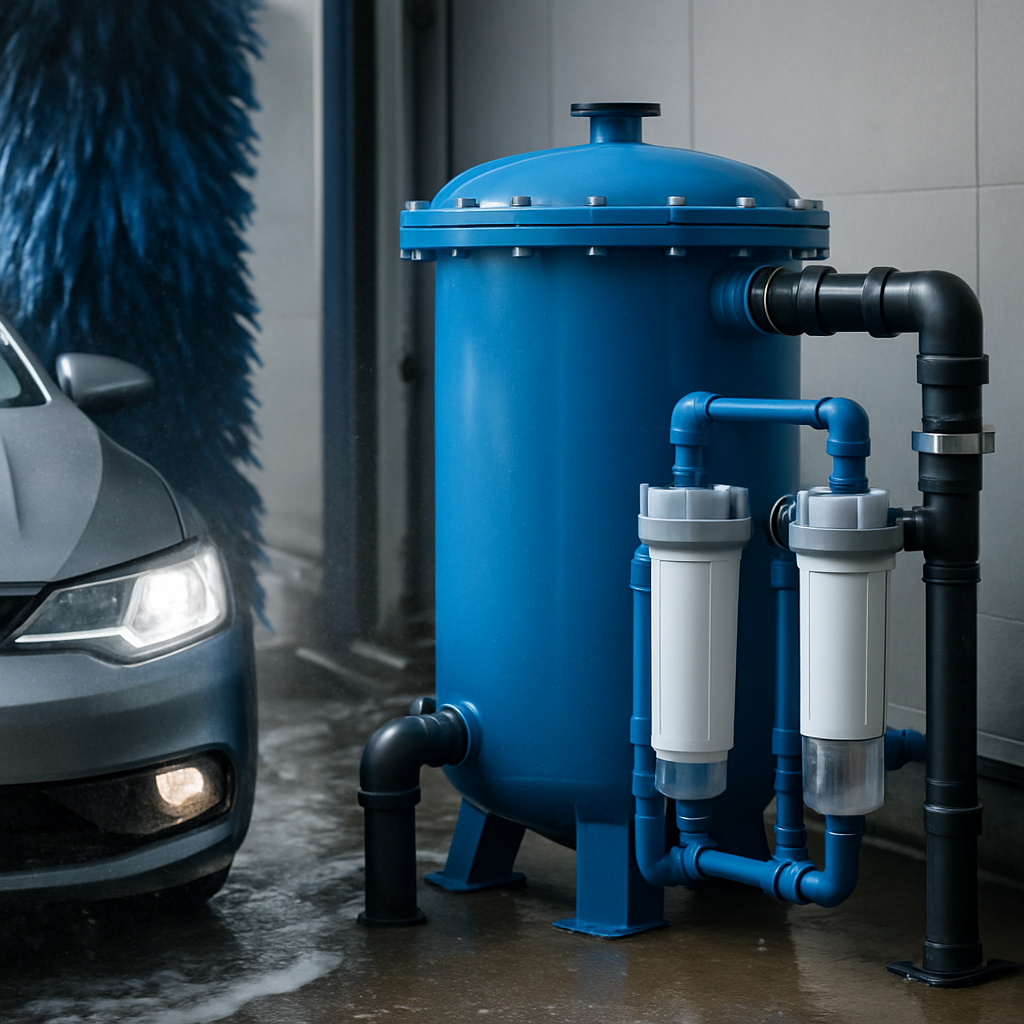
Effective filtration starts with physical capture: grated pads, berms, or engineered wash racks prevent runoff from leaving the work area. From there, trench drains or floor sumps settle heavy grit before a pump sends water into treatment stages. A coalescing oil-water separation unit removes free hydrocarbons, followed by bag or cartridge filtration that targets suspended solids down to the needed micron rating. Where detergents are present or discharge limits are tight, additional steps—such as carbon polishing for residual organics, pH correction, or disinfection via ozone or UV—improve water quality further. In closed-loop reclaim systems, treated water is reused for rinsing, reducing freshwater demand and eliminating offsite hauling.
Not all contaminants behave the same way. Dissolved salts from deicing brines are especially corrosive and aren’t easily removed with standard media filters; facilities with heavy winter exposure may consider advanced options (such as ion exchange or reverse osmosis on a partial side-stream) or rely on managed disposal pathways under local ordinances when reuse isn’t viable. The design goal is to align filtration performance with actual risks and regulatory drivers—often tied to NPDES-related permits, industrial stormwater requirements, or municipal codes. A well-designed wash water filtration strategy safeguards brand reputation, prevents surprise fines, and extends equipment life by limiting salt, grit, and chemicals that accelerate wear.
Designing a Right-Sized System: From Portable Pads to Permanent Wash Bays
Every site is different, but the fundamentals of a right-sized system are consistent: control the footprint of your wash area, meter the flow, remove solids early, separate oils efficiently, and polish to the quality your reuse or discharge plan demands. Start by scoping the basics—available space, power, water source, and the peak gallons per minute expected from your pressure washers. Consider whether you’re washing indoors or outdoors, the temperature swings at your location, and whether operations are seasonal or year-round. Cold climates may require heated pads, insulated enclosures, or glycol-ready plumbing to keep systems online in winter.
Containment often drives success. Above-ground steel wash racks with integrated grating and drip-through channels simplify retrofits on leased sites, while permanent wash bays with trench drains suit higher-throughput facilities. For mobile contractors or on-location cleanups, portable berms and vacuum recovery systems capture water on concrete or compacted surfaces. In all cases, early-stage solids control matters: screens and settling sumps reduce downstream load, cutting media consumption and extending filter life. Many operations pair sumps with sludge carts or dewatering bags to streamline cleanouts and hauling logistics.
Next, sequence treatment to match contaminants. Street fleets and refuse trucks typically benefit from coalescing plate separators for free oil, followed by multi-bag filtration (e.g., 50–25–10 micron) and optional carbon polishing to tackle residual surfactants and odors. Equipment yards with heavy sediment may add a clarifier or polymer-assisted settling to reduce total suspended solids before filtration. If water is reclaimed, plan for detergents: select biodegradable soaps, dose anti-foam if needed, and maintain periodic purges to control dissolved load. Where discharge to sanitary is allowed, confirm local pretreatment limits for oil and grease, pH, and solids—and document your maintenance schedule to keep inspectors confident.
Build maintenance into design. Accessible valves, sight glasses on separators, pressure gauges across filters, and quick-change housings make upkeep predictable. Set filter change-out criteria by pressure drop, not just a calendar. Schedule sump cleanouts based on measured grit accumulation. Train operators to manage foam and watch for emulsified oils (a telltale of overly aggressive degreasers). Safety details—non-slip surfaces, GFCI-protected outlets, clear confined-space designations for pits—help prevent incidents. Whether you deploy a compact skid next to a portable pad or an integrated system feeding a high-throughput bay, these choices create a resilient, compliant, and cost-controlled water reclaim workflow.
Real-World Scenarios: Costs, Compliance Steps, and Performance Benchmarks
Consider a public works yard serving snowplows, dump trucks, and street sweepers in a northern city. Winter operations produce salt-laden spray alongside oily residues and packed grit. The facility installs a grated wash pad that drains to a two-stage sump, followed by a coalescing separator, staged bag filters, and carbon polishing. Operators reclaim a portion of rinse water during peak season while purging at controlled intervals to manage dissolved salts. Downtime drops as corrosive residues are removed more frequently, and maintenance crews note fewer seized fittings and harness failures. With clearly labeled valves, routine sludge removal, and logbook entries for filter changes, the yard maintains strong stormwater compliance posture and predictable costs for solids hauling.
At a construction equipment rental depot, the challenge is abrasive sediment and sticky petroleum soils from lifts, skids, and compactors. A bermed concrete pad feeds a deep grit pit with a removable basket and a secondary clarifier. Operators dose a site-approved polymer during heavy-cleaning days, allowing flocculated fines to settle before pumping the supernatant through a coalescer and 25–10 micron filtration. The result is stable flow, cleaner downstream filters, and reduced media spend. Because detergents vary by job, staff standardize on a low-foaming, quick-rinse product and record dilutions to prevent emulsions that could overwhelm oil-water separation. With these controls, the depot qualifies for sanitary discharge under its local pretreatment permit and avoids offsite disposal for routine operations.
Mobile contractors face a different equation: variable sites, limited space, and tighter timelines. A trailer-mounted recovery system pairs a fold-out containment berm with vacuum pick-up and a compact filtration skid. Debris screens and a small settling tank protect pumps, while multi-stage bag filters remove solids before a coalescer strips free oil. When jobs require closed-loop washing—such as at logistics centers with sensitive storm drains—the contractor recycles treated water, topping up with freshwater as needed. Before mobilizing, the team confirms site rules: where to set up, how to route hoses, and whether any MS4 or facility-specific conditions apply. Consistent procedures and clean documentation help win bids from risk-conscious clients who expect verifiable controls on wash runoff.
Across all scenarios, success hinges on matching benchmarks to your objective. Closed-loop reuse pushes you to manage foam, odors, and emulsions; discharge to sanitary pushes you to hit local limits on oil and grease, pH, and solids; zero-discharge pads push you to schedule purges and hauling with accurate volume estimates. Keep an eye on micron ratings and differential pressures to predict filter life. Track sump cleanout intervals to right-size grit capacity. Verify detergents for reclaim compatibility, and store spare media, seals, and absorbents to avoid downtime. Most importantly, document: equipment specs, maintenance logs, and water quality spot checks. These habits transform wash water filtration from a reactive chore into a reliable, auditable process that protects budgets, brand reputation, and the environment.

Muscat biotech researcher now nomadding through Buenos Aires. Yara blogs on CRISPR crops, tango etiquette, and password-manager best practices. She practices Arabic calligraphy on recycled tango sheet music—performance art meets penmanship.
